





In recent years, pediatric ophthalmologists have observed a dramatic rise in childhood nearsightedness. Driven by increased digital device usage, online schooling, and reduced outdoor playtime, children are developing myopia at younger ages, with prescriptions progressing rapidly throughout their school years.
What’s Covered
- What Causes Childhood Myopia Progression?
- Key Contributing Factors:
- Common Signs Your Child May Have an Undiagnosed Vision Problem
- Evidence-Based Clinical Strategies for Myopia Control
- Why Cycloplegic Refraction is Mandatory in Children?
- Safeguard Your Child’s Vision at Infinite Vision Care
High myopia is not simply an inconvenience requiring thicker spectacle lenses; severe progression significantly increases the lifetime risk of retinal tears, glaucoma, and myopic macular degeneration in adulthood. Consulting a dedicated Ophthalmologist in Kandivali or an experienced eye doctor in Mira Road gives parents access to modern myopia control strategies.
What Causes Childhood Myopia Progression?
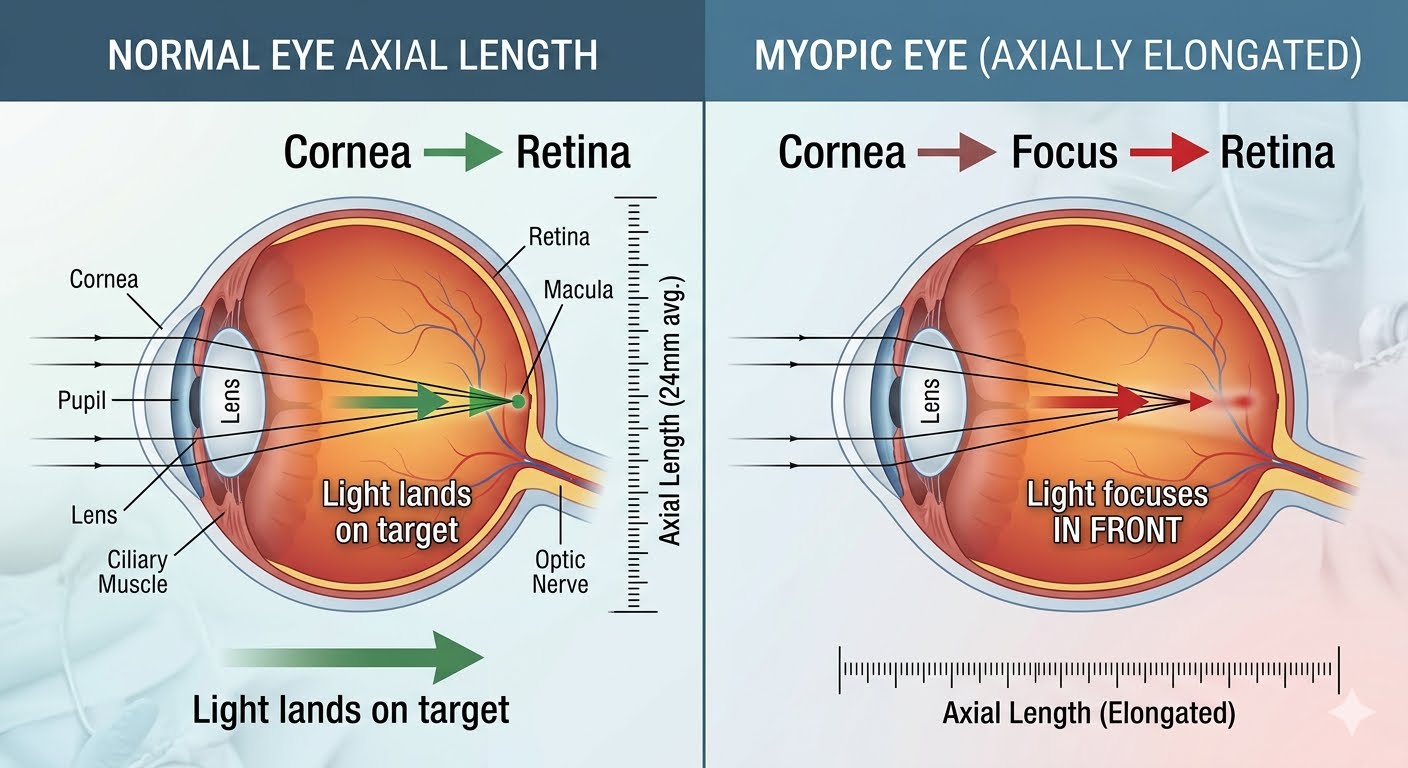
Myopia occurs when the eyeball elongates excessively along its visual axis (axial elongation). When the eyeball grows too long from front to back, incoming light focuses in front of the retina rather than directly on it, causing distant objects to appear blurred.
Key Contributing Factors:
- Prolonged Near-Work Activities: Continuous near-focus demands (smartphones, tablets, books) trigger sustained hyperopic peripheral defocus, signaling the sclera to remodel and the eye to lengthen.
- Lack of Natural Sunlight: Sunlight stimulates the release of retinal dopamine, a neurotransmitter that naturally regulates and slows axial eye growth.
- Genetic Predisposition: A child with one myopic parent is twice as likely to develop myopia; if both parents are myopic, the risk increases five-fold.
Common Signs Your Child May Have an Undiagnosed Vision Problem
Young children rarely complain about blurry eyesight because they assume everyone sees the world exactly as they do. Parents and teachers should watch for these behavioral indicators:
- Sitting unusually close to the television or holding books/screens inches from their face.
- Squinting, tilting the head, or closing one eye while reading or looking at the classroom board.
- Frequent rubbing of the eyes, excessive blinking, or complaints of headaches after school.
- Falling grades, avoidance of reading, or unexplained difficulty with ball sports
Evidence-Based Clinical Strategies for Myopia Control
Modern pediatric eye care does more than prescribe standard single-vision glasses. At a specialized eye clinic in Mira Road, ophthalmologists employ clinically validated strategies to slow axial elongation:

- Low-Dose Atropine Eye Drops (0.01% to 0.05%): Administered once daily at bedtime, low-dose atropine acts on muscarinic receptors to slow axial elongation by up to 50–60% with minimal pupil dilation or near-blur side effects.
- Specialized Defocus Lenses: Advanced spectacle lenses that provide crisp central vision while introducing peripheral myopic defocus, signaling the eye to stop excessive growth.
- Lifestyle and Ergonomic Adjustments: Enforcing the “20-20-20 rule” (every 20 minutes, look at an object 20 feet away for at least 20 seconds) and ensuring at least 90 to 120 minutes of daily natural outdoor play.
Why Cycloplegic Refraction is Mandatory in Children?
Children have strong focusing muscles (ciliary accommodation) that can mask their true refractive error or simulate “pseudo-myopia.”
A routine optical shop assessment without specialized drops often results in over-prescribed lenses that strain young eyes further. A pediatric examination by a qualified eye specialist in Mira Road requires cycloplegic refraction using gentle drops to temporarily relax the focusing muscles—ensuring an accurate optical prescription.
Safeguard Your Child’s Vision at Infinite Vision Care
Healthy vision is essential for academic performance, motor development, and long-term ocular health.
At Infinite Vision Care and Laser Centre, Dr. Shaila Rajkumar Patel provides comprehensive pediatric and adult ophthalmic evaluations:
- Academic Leadership & Expertise: Author in premier ophthalmic references, with deep clinical proficiency in pediatric refractions, amblyopia (lazy eye) management, and corneal health.
- Child-Friendly Diagnostic Care: A calm, welcoming clinical environment equipped to handle cycloplegic refractions, corneal topography, and ocular motility checks.
- Holistic Eye Care: Custom myopia management protocols tailored to your child’s age, visual lifestyle, and progression rate.
Give your child the gift of clear, protected vision. Book an appointment with a top Ophthalmologist in Mira Road at Infinite Vision Care today.
Quick Summary
- There has been a dramatic increase in childhood nearsightedness due to factors like increased digital device usage and reduced outdoor playtime.
- High myopia significantly increases the risk of developing serious eye conditions such as retinal tears, glaucoma, and myopic macular degeneration in adulthood.
- Prolonged near-work activities and lack of natural sunlight are key factors contributing to the progression of myopia in children.
- Children with one myopic parent have double the risk of developing myopia, and the risk increases five-fold if both parents are myopic.
- Low-dose atropine eye drops and specialized defocus lenses are effective clinical strategies used to slow axial elongation in children with myopia.
- Cycloplegic refraction is necessary for children to ensure accurate optical prescriptions, as their strong focusing muscles can mask true refractive errors.